Honor where you are.
If you've been reading my blog lately, you're aware these four simple words have become my mantra in recent weeks. Not only have they helped me in yoga class where I first heard them, they've given me a new appreciation for the writing process.
I heard a new variation of the mantra last night while attempting various asanas with my bum foot, and trying not to compare myself to the vibrant 20-something-year-old balancing next to me with ease.
I used to be flexible like that, I remember thinking while grasping the back of a folding chair for extra balance. I never had to worry about stepping wrong or breaking bones or protecting a broken foot. I used to--
"If you can't reach all the way to the floor," my teacher chimed in over the birdcalls and drums playing out over the class, "reach only as far as you can. Pay attention to posture and positioning." She uncurled from her pose long enough to address us. "As you practice each asana, you're creating new neural pathways--forming memories for the next time. Your body will remember. And when the time is right, when your body is ready, you will reach further."
J guided us from pyramid to warrior three. "Remember," she said as I struggled to balance on my good foot, "where you are now is perfect for you."
Where you are now is perfect for you. Another bit of good advice. One that makes so much sense for so many facets of our life.
It sure fits for writing. Where we are now is perfect for us. The saying is so elegant in its simplicity one could miss the subtle message hidden within. Listen. A gentle "only if" can be found. Where we are now is perfect for us...only if we keep writing, stretching, drafting, revising, and sharing our work with like-minded writers.
With time, with practice, we will come to know our characters fully.
With time, with practice, we will curl up with our pad or sit down at our desktop, and enter our characters so completely that hours later we will have written our way through the entire story.
With time, with practice, we will reach the place in our process when the shape and style of the quilt of our story is obvious.
Honor where you are. Where you are is perfect for you.
Wednesday, April 12, 2006


Tuesday, April 11, 2006
Three Musketeers
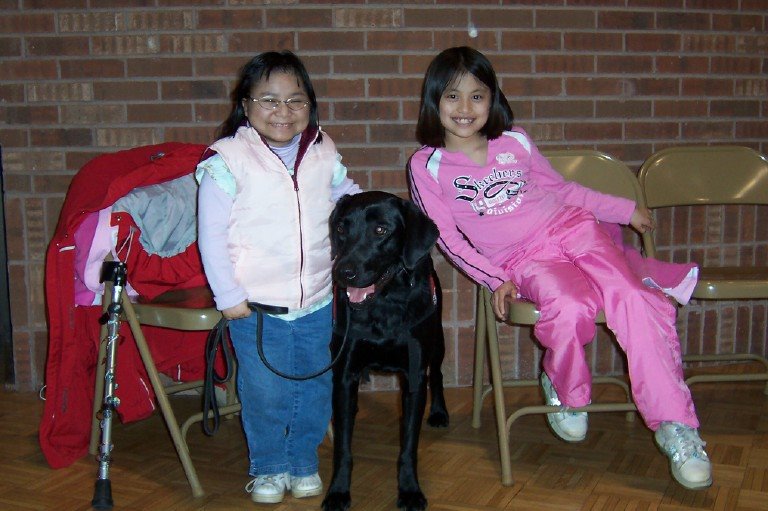
Finding the words to describe the magic working between E and Jewel during each Monday night service dog training is difficult at best. So, here's a picture. E's on Jewel's left, younger sister S (in pink) on the right.
Appetite for writing: Inspired.
Monday, April 10, 2006
Broken Bones, Birthday Dinner, and a Bookstore Date
After loading up on ibuprofen and borrowing a pair of crutches from P's Aunt, P took me to Applebee's Friday night for my birthday. Dinner was far from a five-star affair, but the price was right, the food was quite good, and someone else cooked.
P enjoyed a steaming bowl of shrimp, fettuccini, and veggies in a light alfredo sauce. I feasted on steamed veggies, rice, and mini skewers of marinated beef and shrimp.
Dinner took quite a bit longer than expected because of a full house and a new chef in the kitchen. Fortunately, unlike some of the other patrons who needed to get out in time for a movie, we were in the enviable position of having nowhere to go and plenty to talk about. And bonus for us, we were treated to free desserts on the house because of the wait. P tempted a diabetic coma with a hot double-chocolate-fudge brownie smothered in vanilla ice cream. I savored a slice of chocolate raspberry layer cake drizzled in raspberry sauce.
We continued our evening at Barnes and Noble. Yes, that's right. A bookstore.
Now, for some of you, the concept of a bookstore date probably sounds less than romantic. But for P and I...well, let's just say roaming the aisles sans children was just what we needed. First we haunted the scifi/fantasy shelves looking for new titles by favorite authors. Next, we oohed and ahhed over cover artwork, and sampled first pages of potential new favorites. Then we wandered the rest of the store, ending up in the bargain bin area with an armload of books, and wish lists for both of us.
The birthday celebration continued Saturday with presents from the girls. I'm now the proud owner of a tabletop Zen garden, an authenic crystal ball, subscription to Writer's Journal, and my own copy of The Book Thief by Markus Zusak.
Appetite for writing: Hungry.
Current read: The Blue Girl by Charles de Lint.
On deck: Twilight by Stephenie Meyer, reviewed recently by Cynthia Leitich Smith here, and The Book Thief by Markus Zusak reviewed here.
P enjoyed a steaming bowl of shrimp, fettuccini, and veggies in a light alfredo sauce. I feasted on steamed veggies, rice, and mini skewers of marinated beef and shrimp.
Dinner took quite a bit longer than expected because of a full house and a new chef in the kitchen. Fortunately, unlike some of the other patrons who needed to get out in time for a movie, we were in the enviable position of having nowhere to go and plenty to talk about. And bonus for us, we were treated to free desserts on the house because of the wait. P tempted a diabetic coma with a hot double-chocolate-fudge brownie smothered in vanilla ice cream. I savored a slice of chocolate raspberry layer cake drizzled in raspberry sauce.
We continued our evening at Barnes and Noble. Yes, that's right. A bookstore.
Now, for some of you, the concept of a bookstore date probably sounds less than romantic. But for P and I...well, let's just say roaming the aisles sans children was just what we needed. First we haunted the scifi/fantasy shelves looking for new titles by favorite authors. Next, we oohed and ahhed over cover artwork, and sampled first pages of potential new favorites. Then we wandered the rest of the store, ending up in the bargain bin area with an armload of books, and wish lists for both of us.
The birthday celebration continued Saturday with presents from the girls. I'm now the proud owner of a tabletop Zen garden, an authenic crystal ball, subscription to Writer's Journal, and my own copy of The Book Thief by Markus Zusak.
Appetite for writing: Hungry.
Current read: The Blue Girl by Charles de Lint.
On deck: Twilight by Stephenie Meyer, reviewed recently by Cynthia Leitich Smith here, and The Book Thief by Markus Zusak reviewed here.
Friday, April 07, 2006
Terrified by the Idea of Pitching an Editor? Read this.
We writers are a fickle bunch. Given the challenge, we'll gladly write someone's way to freedom, and or spend months or longer holding our character's hand as she journeys there and back again. Put us in a room with an editor willing to hear our pitch, however, and many of us make ourselves sick at the prospect. Not because we don't want to be there, but because given the choice, most writers I know (including yours truly) would rather observe the center of attention than be it.
So, what's a writer to do if given the opportunity to pitch an editor? Tor editor Anna Genoese demystifies the process in her online journal entry here.
Appetite for writing: Munchy. Working on an author interview, a couple of articles, a little of this and a little of that while nursing a twisted ankle (which may actually be broken.)
I fell this am while heading into yoga. The cracking sound I heard when I went down was either my foot or the scrape of my shoe against the sidewalk. Judging by the pain I'm experiencing six hours later, I'm betting it's not a bad sprain.
Headed to Quick Care after the girls get home. Hoping I won't spend the rest of my birthday hobbling around on a cast.
Edited to add: It's broken. Two places, maybe a third.
So, what's a writer to do if given the opportunity to pitch an editor? Tor editor Anna Genoese demystifies the process in her online journal entry here.
Appetite for writing: Munchy. Working on an author interview, a couple of articles, a little of this and a little of that while nursing a twisted ankle (which may actually be broken.)
I fell this am while heading into yoga. The cracking sound I heard when I went down was either my foot or the scrape of my shoe against the sidewalk. Judging by the pain I'm experiencing six hours later, I'm betting it's not a bad sprain.
Headed to Quick Care after the girls get home. Hoping I won't spend the rest of my birthday hobbling around on a cast.
Edited to add: It's broken. Two places, maybe a third.
Thursday, April 06, 2006
What Yoga Taught Me About Writing, Part III
I made another connection between yoga and writing recently.
As J was leading us through a series of asanas--from sun salutation to warrior's pose to triangle and back again--something she said resonated with me.
"Yoga is nonjudgmental," she said. "Don't worry about what your neighbors are doing. Don't force the pose. Where you are is right for you."
Where you are is right for you.
After a frustrating day creative wise, the advice was so what I needed to hear that I nearly fell out of downward dog. I moved into warrior's pose, breathing deeper into my lunge, imagining the weight of a blade balanced in my outstretched hand.
J flowed into triangle then back into sun salutation. "Do not force the pose," she said once more. "Honor where you are."
Cue the light-bulb-moment music.
How many times have we compared ourselves to other writers, worried that we're not working hard enough or fast enough to win success at the same rate? Why can't we honor where we are instead of worrying that we'll never be good enough? Who knew that the words I needed to hear that day--the words that have now become my mantra--could be found in such an ancient art?
Honor where you are.
I am so not dropping this class.
As J was leading us through a series of asanas--from sun salutation to warrior's pose to triangle and back again--something she said resonated with me.
"Yoga is nonjudgmental," she said. "Don't worry about what your neighbors are doing. Don't force the pose. Where you are is right for you."
Where you are is right for you.
After a frustrating day creative wise, the advice was so what I needed to hear that I nearly fell out of downward dog. I moved into warrior's pose, breathing deeper into my lunge, imagining the weight of a blade balanced in my outstretched hand.
J flowed into triangle then back into sun salutation. "Do not force the pose," she said once more. "Honor where you are."
Cue the light-bulb-moment music.
How many times have we compared ourselves to other writers, worried that we're not working hard enough or fast enough to win success at the same rate? Why can't we honor where we are instead of worrying that we'll never be good enough? Who knew that the words I needed to hear that day--the words that have now become my mantra--could be found in such an ancient art?
Honor where you are.
I am so not dropping this class.
Wednesday, April 05, 2006
Crit Groups, Time Sinks, and Other Misconceptions
A number of writers I know consider critique groups time sinks. I used to feel the same way--until Vermont College taught me otherwise.
Crit groups--the ones that really work--don't dampen the writing process, they inform it. Sure, critiques take time, and sharing your writing when it's still raw can be a nerve-wracking experience. But if our true aim is to grow our writing and share it with the rest of the world, don't we owe it to ourselves to take advantage of the experience?
The problem is not all crit groups work. And if you're like me, you can recall at least one time when you were critiqued by someone who was less than constructive about what worked and what didn't in a piece.
I've come to believe that one of the main reasons crit groups fail is that the majority of members think with a writer's heart instead of an editor's ear. I'm the first to admit I used to give critiques this way. Over the years, I've praised beautifully written prose that stalled the plot rather than propelled it. I've allowed favorite characters to act out of character rather than question the authenticity of their actions. And I've endured hours of debate about proper comma placement instead of redirecting discussions toward more substantive issues, such as plot, character, and setting.
Unfortunately, safe approaches may protect feelings, but they don't serve the story. Or the writer hoping to reduce the number of rejections gracing his or her mailbox.
Don't get me wrong. I'm not advocating cutthroat critiquing. No writer needs a group like that--not when our inner critics give us enough of a beating on their own, thank you. What I am suggesting is that we owe it to our process and our fellow writers to hone our editor's ear because only through honesty can we ever truly grow our craft.
For the record, my own editor's ear is far from perfect. But it's getting more reliable thanks to fellow crit group members I can trust to be honest, and a few techniques I've picked up along the way:
*Eliminate use of the word "you" when giving a critique. Face it. Launching any crit with "you should write it this way," or "you shouldn't write it that way" sets up the listener to be defensive from the get go.
*Since one of the main reasons for meeting regularly with other writers is to get support and encouragement, start with the positives in a piece. Lift up its strengths, follow with questions it raised, and close again with strengths.
*Don't get hung up on commas and line edits. Think globally--about plot, and themes, and imagery, and setting. Sure, strong writing will carry a piece a long way, but few manuscripts will merit a second look if the plot makes no sense, or the characters are unbelievable.
*Read. Read. Read. If a book really works for you, find the parts you like. Dissect them line by line, word by word, until you're able to define what's working and why. If you lose interest in a book halfway, investigate what bugged you about the book. Did the plot collapse? Are the characters acting out of character? Identify what caused you to lose interest, so that you can avoid the same mistake(s) in your own writing, and articulate those problem areas in others' work.
*Don't stay in a group that berates, or praises everything. Find another group or start your own with members willing to be as honest about your work as you are about theirs.
Appetite for writing: On hold this morning. On my way to crit group. Eager to hear what my fellow writer/editors thought of my latest installment.
Crit groups--the ones that really work--don't dampen the writing process, they inform it. Sure, critiques take time, and sharing your writing when it's still raw can be a nerve-wracking experience. But if our true aim is to grow our writing and share it with the rest of the world, don't we owe it to ourselves to take advantage of the experience?
The problem is not all crit groups work. And if you're like me, you can recall at least one time when you were critiqued by someone who was less than constructive about what worked and what didn't in a piece.
I've come to believe that one of the main reasons crit groups fail is that the majority of members think with a writer's heart instead of an editor's ear. I'm the first to admit I used to give critiques this way. Over the years, I've praised beautifully written prose that stalled the plot rather than propelled it. I've allowed favorite characters to act out of character rather than question the authenticity of their actions. And I've endured hours of debate about proper comma placement instead of redirecting discussions toward more substantive issues, such as plot, character, and setting.
Unfortunately, safe approaches may protect feelings, but they don't serve the story. Or the writer hoping to reduce the number of rejections gracing his or her mailbox.
Don't get me wrong. I'm not advocating cutthroat critiquing. No writer needs a group like that--not when our inner critics give us enough of a beating on their own, thank you. What I am suggesting is that we owe it to our process and our fellow writers to hone our editor's ear because only through honesty can we ever truly grow our craft.
For the record, my own editor's ear is far from perfect. But it's getting more reliable thanks to fellow crit group members I can trust to be honest, and a few techniques I've picked up along the way:
*Eliminate use of the word "you" when giving a critique. Face it. Launching any crit with "you should write it this way," or "you shouldn't write it that way" sets up the listener to be defensive from the get go.
*Since one of the main reasons for meeting regularly with other writers is to get support and encouragement, start with the positives in a piece. Lift up its strengths, follow with questions it raised, and close again with strengths.
*Don't get hung up on commas and line edits. Think globally--about plot, and themes, and imagery, and setting. Sure, strong writing will carry a piece a long way, but few manuscripts will merit a second look if the plot makes no sense, or the characters are unbelievable.
*Read. Read. Read. If a book really works for you, find the parts you like. Dissect them line by line, word by word, until you're able to define what's working and why. If you lose interest in a book halfway, investigate what bugged you about the book. Did the plot collapse? Are the characters acting out of character? Identify what caused you to lose interest, so that you can avoid the same mistake(s) in your own writing, and articulate those problem areas in others' work.
*Don't stay in a group that berates, or praises everything. Find another group or start your own with members willing to be as honest about your work as you are about theirs.
Appetite for writing: On hold this morning. On my way to crit group. Eager to hear what my fellow writer/editors thought of my latest installment.
Monday, April 03, 2006
Join the Wild Rumpus! Third Carnival of Children's Literature Opens its Gates
Step right up to the Third Carnival of Children's Literature. Hosted by Sherry Early, author and creator of Semicolon, the carnival promises a month's worth of hooting and hollering. Consider bookmarking the site so you don't miss out on any of the fun. I'm heading over today for an unlimited ride bracelet. See you there.
Subscribe to:
Posts (Atom)

 Posts
Posts


